Bungalow or HMO? Choosing the Right Format for Supported Living
When a care provider approaches us with a housing requirement, the conversation usually starts with a location and a number of residents. The format — whether that’s a shared house, a bungalow, or a cluster of self-contained units — tends to be treated as a detail to settle later.
It shouldn’t be. Format determines how a property functions day to day, what it costs to staff, and whether it still works when a resident’s needs change in three years’ time. It is worth deciding deliberately.
The shared HMO
A four to six bed house in multiple occupation is the most common format in supported living, and for good reason. It spreads the cost of a property across more residents, which keeps rents affordable and makes the scheme viable in areas where housing is expensive. Communal kitchens and living space encourage interaction, which suits residents who benefit from company and gentle social structure.
It works best for people with low to moderate support needs who can manage a degree of shared living. It works less well where residents need substantial personal space, where behaviours make cohabitation difficult, or where the mix of residents can’t be carefully controlled.
The practical questions we ask: can every bedroom take an ensuite? Is there a room that can serve as a sleep-in for waking or overnight staff? And is the property large enough that communal space doesn’t disappear once bedrooms are maximised?
The shared bungalow
A two or three bedroom bungalow gives you everything a house does, on one level. For residents with physical disabilities or degenerative conditions, that single fact removes the biggest long-term constraint on a property: stairs.
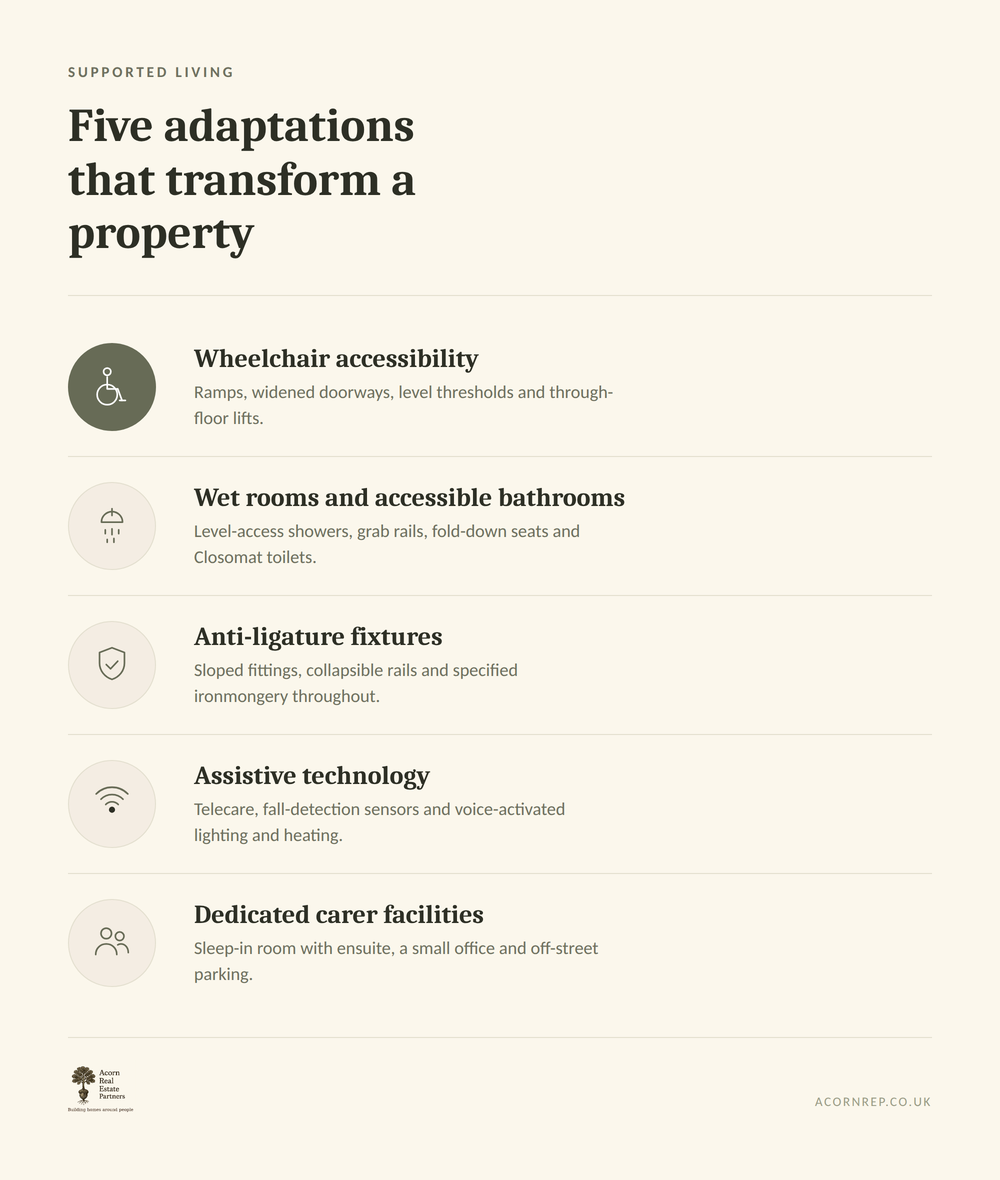
Bungalows are also the easiest format to bring up to M4(3) wheelchair-accessible standard. Doorways widen, thresholds level out, and a wet room replaces a bathroom without the structural work that the same specification demands in a two-storey house.
The trade-off is supply and price. Bungalows are scarcer than houses across most of the Midlands and Yorkshire, they attract competition from downsizers, and they cost more per square foot.
Two self-contained units
The third option is less familiar but increasingly the right answer: a single site delivering two entirely self-contained one-person bungalows, with an on-site carer’s facility serving both.
This suits residents who need their own front door — people for whom shared living isn’t appropriate, but who don’t require the cost base of a fully independent placement with its own staffing. The provider gets the efficiency of one staffing arrangement across two residents. Each resident gets genuine independence, their own kitchen, their own space, and no requirement to negotiate with a housemate.
It also ages well. As needs change, two self-contained units can be re-let independently, where a shared house has to be re-let as a whole or not at all.
How to choose
In practice, the decision comes down to four questions.
Can these residents share? Not whether they could be made to, but whether the placement is likely to hold for years.
What does the support model actually require? Waking nights, sleep-ins and visiting support each imply different space.
What happens in five years? A property that only works for one specific cohort is a property with a short life.
What is available? The best format on paper is no use if nothing suitable exists in the catchment area at a price that works.
We source and adapt for all three formats, and we’d generally rather have this conversation before a property is identified than after. If you have a requirement coming up, get in touch — we’re happy to talk it through even at the point where all you have is a rough number and an area.
← All insights